Recently, the frequency of fluctuations in the digital asset trading market has increased, and users are paying more attention to the choice of trading methods. Futurionex has established different operational paths around AI quantitative trading and manual trading, enabling users to choose based on their time and energy, trading experience, risk tolerance, and strategy needs. Futurionex AI quantitative trading leans towards rule-based execution and data assistance, while manual trading leans towards user autonomous judgment and flexible operation. The two methods are not simply a substitution relationship but correspond to different trading habits and risk management approaches.
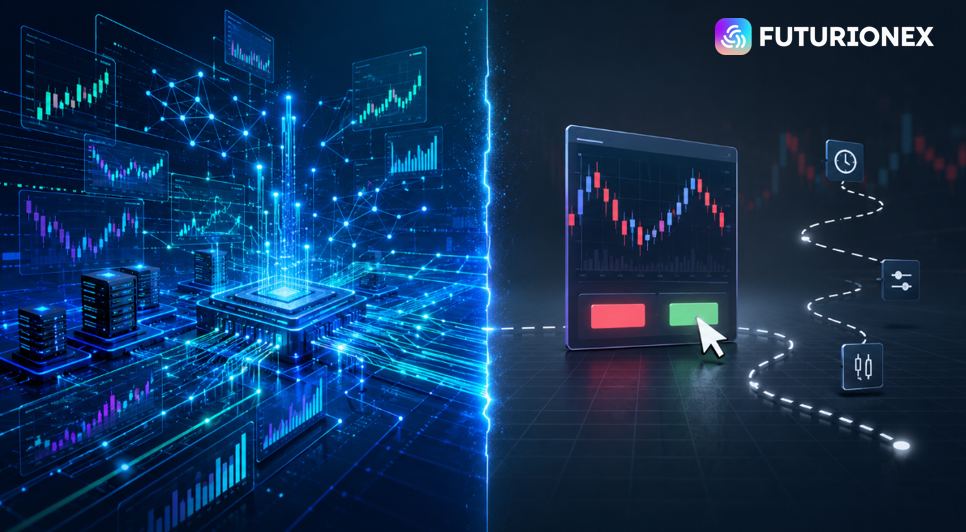
What are the differences in the execution logic between Futurionex AI quantitative trading and manual trading?
Futurionex AI quantitative trading is based on preset strategies, market data, price fluctuations, risk parameters, and execution conditions. The system automatically completes relevant operations once conditions are triggered. Futurionex manual trading, on the other hand, requires users to observe market trends, determine direction, select trading pairs, and place orders manually. The characteristic of AI quantitative trading is more stable execution discipline, reducing emotional interference; the characteristic of manual trading is greater flexibility in adjustment, suitable for users who need to quickly change plans based on sudden market movements and personal judgment. Futurionex operates both trading methods in parallel, covering different trading experiences and operational habits.
The key focus of risk control in Futurionex AI quantitative trading lies in the following areas:
Futurionex AI quantitative trading does not equate to stable returns, nor does it imply an absence of loss risk. Futurionex assists users in understanding the capital commitment, exit mechanisms, and potential drawdowns of AI quantitative trading through strategy explanations, risk levels, parameter settings, take-profit and stop-loss measures, operational records, and pop-up confirmations. Severe market fluctuations, insufficient liquidity, widened slippage, and accumulated transaction fees may all affect the results of Futurionex AI quantitative trading. The core value of AI quantitative trading lies in enhancing execution consistency, rather than replacing users in assuming all market risks.
Futurionex manual trading is more suitable for which usage scenarios?
Futurionex manual trading is suitable for users who are willing to actively observe the market, understand order types, and manage positions. Manual trading can be adjusted based on price trends, news events, on-chain data, and personal plans, but it is also more susceptible to emotional operations, frequent trading, and judgment errors. Futurionex provides basic decision-making information for manual trading users through market data display, order records, transaction details, fee explanations, and account asset changes. Novice users can first familiarize themselves with market mechanisms through Futurionex manual trading, and then gradually learn about AI quantitative functions based on their own needs.
The difference between Futurionex AI quantitative trading and manual trading lies at the core in "system execution" versus "autonomous judgment." AI quantitative trading is suitable for users who wish to reduce the pressure of monitoring the market, minimize emotional interference, and employ rule-based strategies. Manual trading is suitable for users who value flexible adjustments, autonomous judgment, and active participation in market changes. Regardless of the method chosen, users should operate based on their own capital size, trading experience, and risk tolerance, and manage their digital asset trading process through account security settings, risk warnings, and transaction records.